


Last updated: April 18, 2026
Quick Answer
The EU Entry/Exit System (EES) is now live at French borders, and it is causing significant delays at Paris airports. Non-EU travellers arriving at CDG or Orly should expect longer immigration queues — potentially two to three hours — due to biometric registration requirements and ongoing technical problems with automated kiosks. If you are flying into France in 2026, plan extra time, confirm your passport is machine-readable, and consider professional airport pickup support to reduce stress once you clear border control.
Key Takeaways
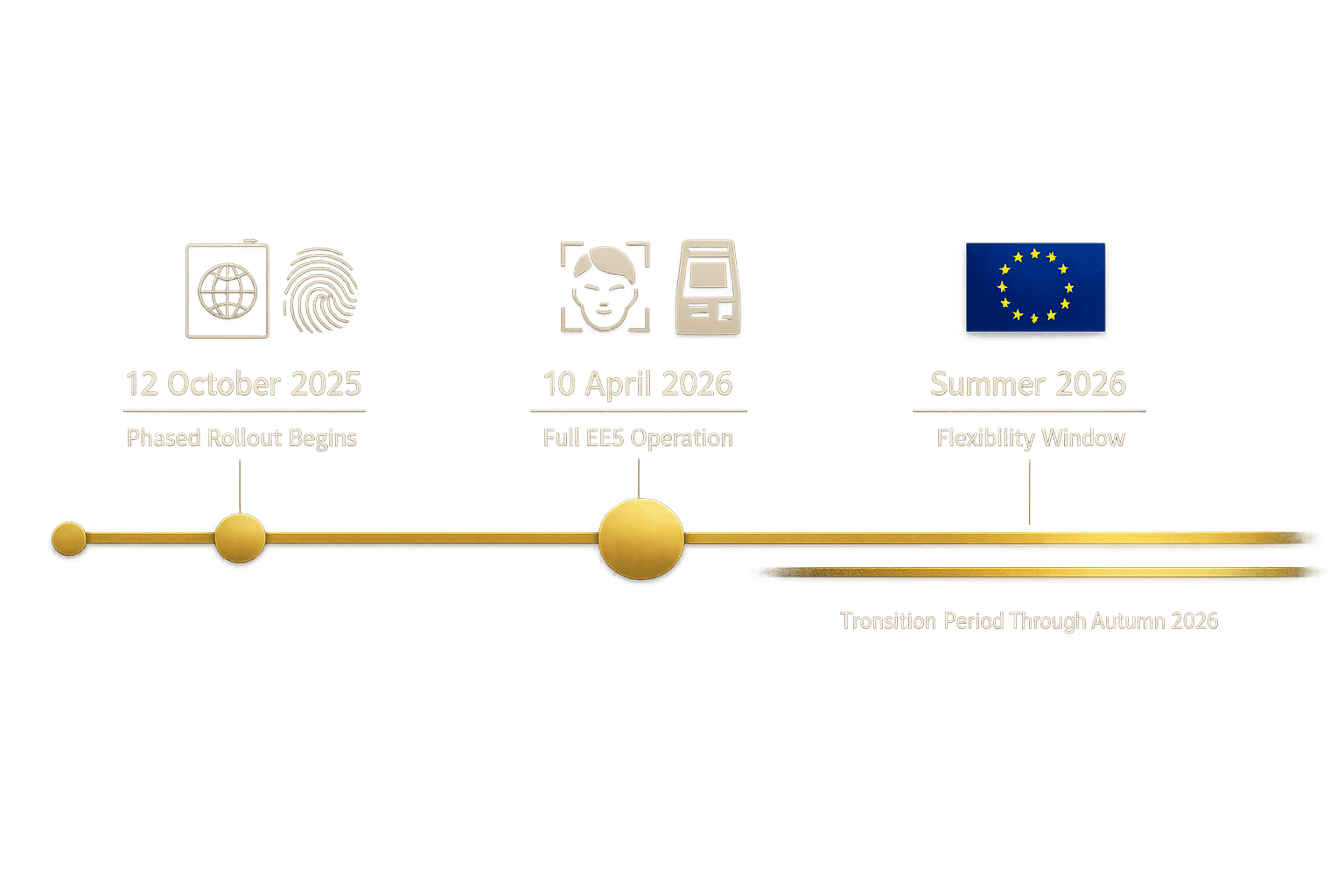
- EES is operational. The phased rollout started on 12 October 2025 and became fully operational from 10 April 2026 across 29 Schengen area countries [1].
- France is struggling. Paris-CDG and Orly airports experienced automated kiosk crashes and three-hour immigration queues during the first weekend of full operation [5].
- Biometric data is required. Every non-EU traveller must provide four fingerprints and a facial image on their first visit to the Schengen area under EES [5].
- Manual fallbacks are in use. French airports have temporarily disabled biometric capture when queues exceed 45 minutes, reverting to manual stamping of passports [5].
- ETIAS is separate. The European Travel Information and Authorisation System (ETIAS) is a different pre-travel requirement — not yet enforced — and should not be confused with EES.
- Flexibility exists. Member states may suspend or reduce EES checks for up to 90 days after April 9 to manage congestion [3].
- Arrive early. Business-travel advisors now recommend arriving at least four hours before departure from French airports [5].
- Your pickup matters. A professional airport transfer with Meet & Greet ensures your chauffeur is waiting — regardless of how long border control takes.
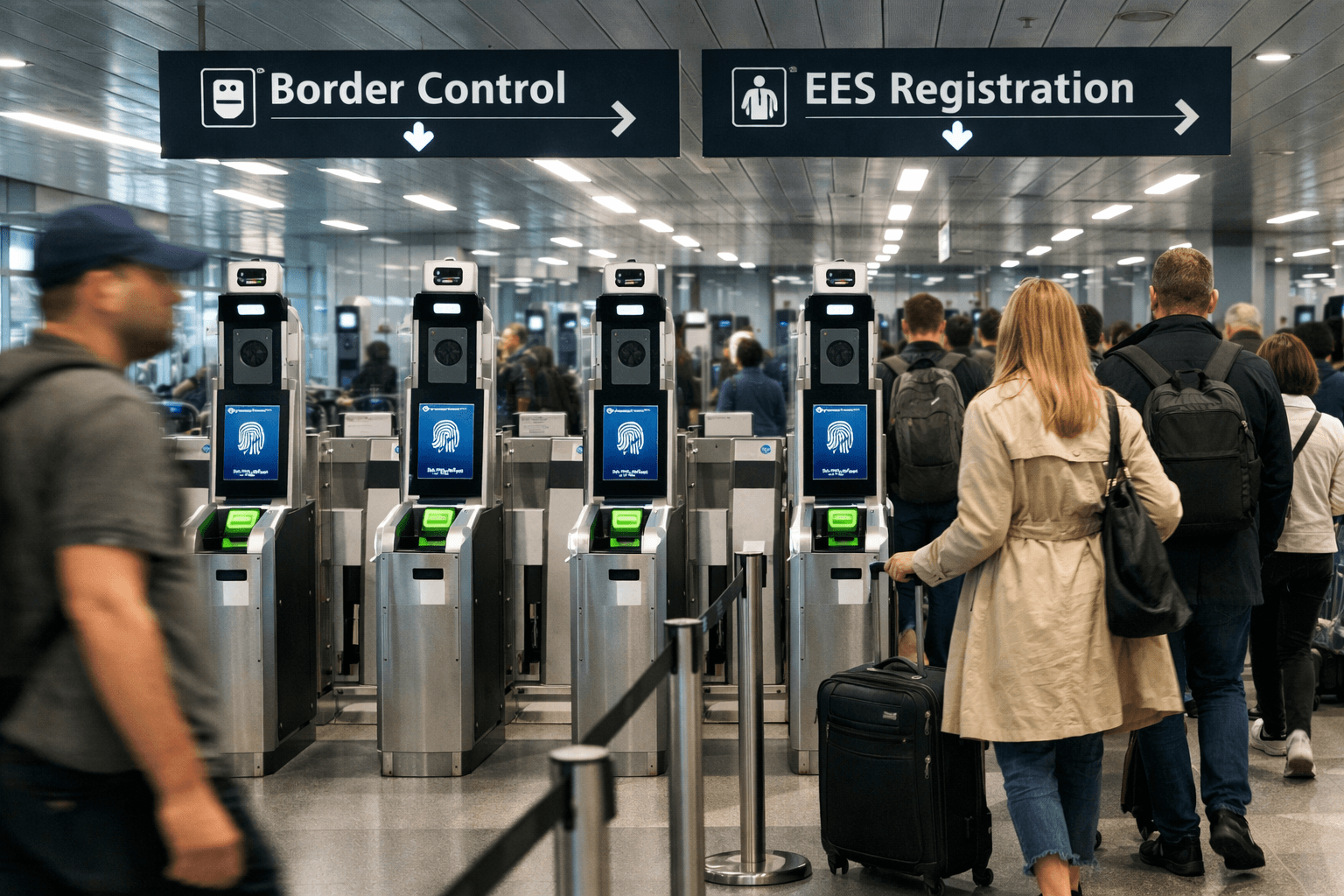
EU Airports Report Three-Hour Delays Caused by New Entry-Exit System
Three-hour immigration queues are not hypothetical — they happened on the very first weekend the EES system went fully live in France. On April 11–12, 2026, passengers at Paris-CDG and Orly faced extreme wait times as automated kiosks crashed repeatedly, forcing border guards to revert to manual passport processing [5].
Airlines for Europe (A4E) and ACI Europe jointly described the rollout as a “systemic failure” and formally requested the European Commission to authorize suspension of EES through the end of summer [5]. The situation also affected the Eurostar route from St Pancras to Paris and the Eurotunnel terminal, with some travellers missing departures entirely.
What this means for you: If France is part of their itinerary, every non-EU traveller arriving at a French airport or port should budget substantially more time for border formalities. The EES represents a €1.3 billion investment by the European Union, but infrastructure readiness at France’s busiest airports has not matched the ambition [5].
Practical tip: We monitor flight arrivals in real time. Your chauffeur adjusts pickup timing accordingly, so even a three-hour delay at immigration does not leave you stranded. Learn how our airport pickup works.
EU Airport Entry-Exit System Delays: What Went Wrong in France
France — the world’s most visited country — was “far from ready” just two days before the April 10 launch [4]. Despite a six-month progressive rollout phase that started on 12 October 2025, French airports had not resolved critical technical issues with their kiosk infrastructure.
Here is what travellers are encountering:
- Kiosk reboots: Automated EES kiosks at CDG and Orly crash mid-registration, requiring travellers to restart the biometric enrollment process [5].
- Manual fallback: When queues exceed 45 minutes, French airports temporarily disable biometric capture and revert to stamp-based processing [5].
- Re-enrollment risk: After a kiosk reboot, a traveller may be asked to complete EES registration again from scratch [5].
- Uneven Schengen implementation: Some Schengen countries are processing non-EU nationals smoothly, while France and others remain significantly behind schedule [4].
The European Commission has acknowledged these challenges. EU rules allow Schengen area countries limited temporary flexibility to suspend or reduce ees checks for up to 90 days, with a possible 60-day extension ending no later than early September 2026 [3].
How the EES System Works: Border Control, Biometrics, and Your Passport
The EES replaces the manual stamping of passports with a digital record of every entry and exit. When a non-EU traveller crosses an external border of the Schengen area for a short stay (up to 90 days within any 180-day period), the system will create a digital record containing:
| Data Collected | Details |
|---|---|
| Identity | Name, date and place of birth, nationality |
| Travel document | Passport number, expiry date |
| Biometric data | Four fingerprints and facial images |
| Border crossing | Date and place of entry and exit |
| Stay calculation | Automatic 90/180-day tracking |
On your first visit to the Schengen area under EES, you need to provide fingerprints and facial images at a kiosk or to a border guard. This ees registration is completed at the border — there is no pre-registration option. Subsequent crossings should be faster, as your biometric data will be used to verify identity without full re-enrollment.
Who is exempt from EES?
- EU citizens and their family members holding a residence permit
- Nationals of countries listed as exempt under specific bilateral agreements
- Holders of certain diplomatic or service travel documents
If you hold a visa for a short stay or are a visa-exempt non-EU national (such as UK nationals), you are not exempt from EES. You will need to complete ees checks the first time they cross into any country in the Schengen area.
The UK government’s gov.uk guidance confirms that British passport holders must comply with EES when entering the Schengen area, including France [1]. This applies whether arriving by air at European airports, by rail via Eurostar, or by sea through a port such as the port of Dover or a French border crossing.
ETIAS and the European Travel Information and Authorisation System: What Travellers Need to Know
ETIAS is not the same as EES — and it is not yet in force. The European Travel Information and Authorisation System (also called the electronic travel authorisation) is a separate pre-travel screening requirement for visa-exempt non-EU nationals. As of early 2026, ETIAS has not launched, though it is expected to become operational later in 2026 or in autumn 2026.
Here is how the two systems differ:
| EES | ETIAS | |
|---|---|---|
| Status | Live since 12 October 2025; fully operational from 10 April 2026 | Not yet operational |
| What it does | Records entry and exit at the border | Pre-screens travellers before travel |
| When you interact | At the border (kiosk or border guard) | Online, before departure |
| Who it applies to | All non-EU short-stay travellers | Visa-exempt non-EU nationals only |
| Biometrics | Fingerprint and facial image required | No biometrics |
| Cost | Free | Expected fee (approx. €7) |
Travellers should not confuse the two. You do not need to apply for ETIAS yet. However, you do need to comply with EES if you are entering the Schengen area as a non-EU traveller in 2026.
For the latest official guidance, the UK government recommends checking gov.uk before travel. The European Commission also publishes updates on participating countries and EES records processing [1].
A note on Switzerland: Switzerland is part of the Schengen area but not the European Union. EES applies at Swiss borders as well. If Switzerland or any other Schengen area countries are on your route, the same ees system rules apply.
EU Entry Exit System Airport Delays: How to Plan Your Paris Arrival
The single most important thing you can do is allow extra time — and ensure someone reliable is waiting for you on the other side. Here is a practical checklist for arriving at a French airport under EES in 2026:
Before You Travel
- Confirm your passport is machine-readable and valid for at least three months beyond your planned stay.
- Check gov.uk or your national government’s travel advice for the latest EES and border control updates.
- Do not confuse EES with ETIAS — you do not need to apply for anything in advance for EES. Registration is done at the border.
- Book your airport transfer in advance. A private chauffeur service with real-time flight monitoring eliminates the stress of unpredictable wait times.
At the Airport
- Follow signs to EES kiosks or the manned border control lane for non-EU passport holders.
- Be prepared to provide four fingerprints and a facial image if this is your first time under EES.
- You may be asked for your travel document, proof of accommodation, or return ticket by a border guard.
- If a kiosk crashes, stay in line — officers will process you manually or direct you to another kiosk.
- Budget 60–120 minutes for immigration at CDG during peak periods. Orly may be slightly faster; Beauvais has fewer resources.
After Border Control
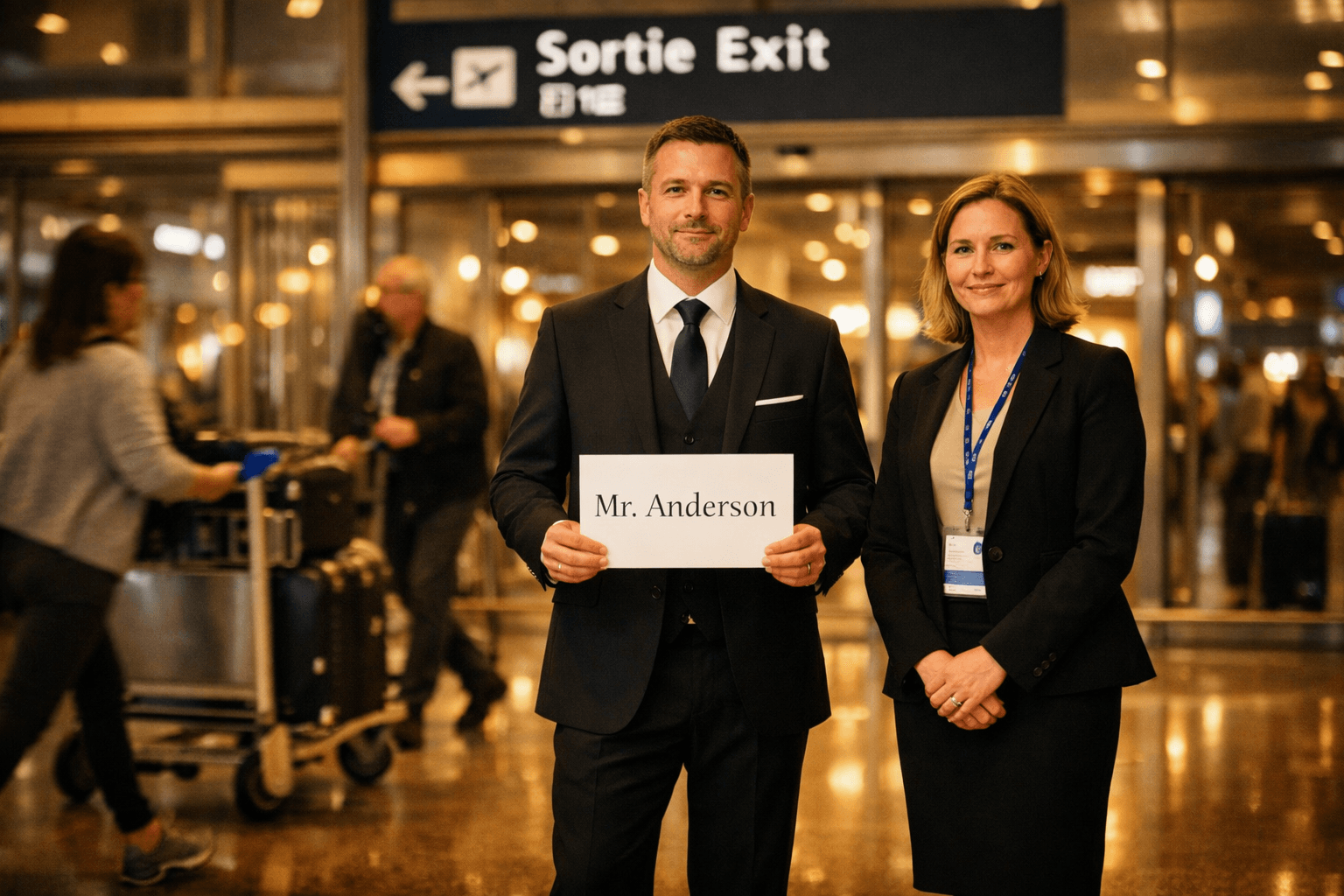
- Your chauffeur is waiting. With our standard Meet & Greet — included with every booking — your English-speaking driver holds a personalized sign in the arrivals hall, assists with luggage, and escorts you directly to your latest Mercedes Business Edition vehicle.
For travellers who want to bypass as much friction as possible, our VIP Meet & Assist with Fast Track provides personalized welcome at the aircraft door, fast-track through immigration where available, porter service, and direct escort to your chauffeur. This can save 30–45 minutes in suitable cases — a meaningful difference when EES queues are long.
Who Is Exempt from EES and Who Must Register at French Borders
Most international visitors to France are not exempt. EU citizens and holders of a valid residence permit issued by a member state do not need to register. Everyone else — including UK nationals, Americans, Canadians, Australians, and nationals of countries requiring a visa — must complete ees registration.
Key groups affected:
- Non-EU visa-free nationals (UK, US, Canada, Australia, Japan, etc.): Must register with biometric checks on first entry.
- Non-EU visa holders: Must also register. Your visa does not exempt you from EES.
- Schengen residents with permits: Exempt from EES if holding a valid residence permit from a member state.
- Diplomats and service passport holders: May be exempt depending on specific agreements.
The new system applies at all external borders of the Schengen area — air, land, and sea. Whether you arrive at CDG, cross the French border by car, or dock at a port, the same rules apply. Travellers departing from Dover or the port of Dover via ferry will also encounter EES checks at the uk port before boarding, as French border officers operate there under juxtaposed controls.

Why a Professional Airport Pickup Matters More Than Ever
With EES adding unpredictability to every non-EU arrival, the value of a professional, patient chauffeur service has never been clearer. A taxi meter running while you are stuck in a three-hour immigration queue is not luxury — it is stress.
We operate differently. Every airport transfer includes:
- ✅Real-time flight monitoring — your chauffeur adjusts to delays automatically
- ✅Meet & Greet included — personalized sign, luggage assistance, escort to vehicle
- ✅All-inclusive rates — no hidden fees, no surge pricing, no meter anxiety
- ✅Latest Mercedes fleet — E-Class, S-Class, or V-Class depending on your party size
- ✅English-speaking chauffeurs — professional, discreet, and knowledgeable
For families arriving with children, heavy luggage, or larger groups, our Mercedes V-Class offers the space and comfort you need after a long journey. Child seats are available on request. For business executives or VVIP arrivals, the Mercedes S-Class paired with VIP Meet & Assist delivers a stress-free airport arrival curated with precision.
Whether your destination is central Paris, Disneyland Paris, or Versailles, we provide door-to-door service with white-glove logistics and a dedicated ground controller for complex itineraries.
Real-Time Monitoring and Communication
Our 24/7 private chauffeur service includes a dedicated ground controller who monitors:
- Live flight arrival data
- CDG border control queue status (where available)
- Passenger communication via WhatsApp or SMS upon landing
This white-glove logistics approach ensures that no client is left waiting at the curb, and no chauffeur is positioned too early — wasting time in a restricted zone.
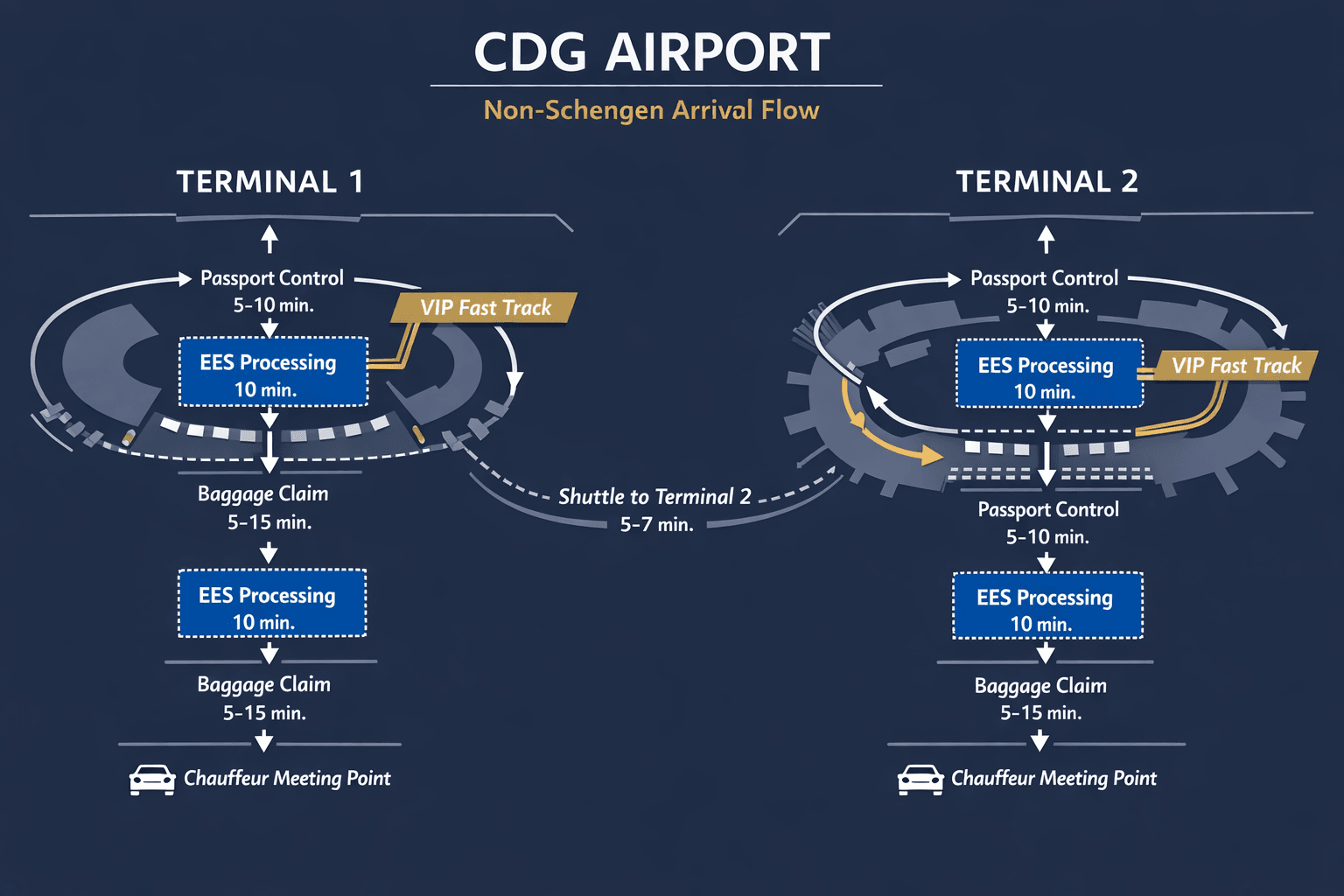
How Does VIP Meet & Assist Fast-Track Work Under EES at CDG?
The VIP Meet & Assist service at Paris CDG with fast-track concierge is the most effective way to minimize EES processing time for non-Schengen arrivals. This is the single most impactful upgrade available for international travelers arriving at CDG in 2026.
Here is how the service works, step by step:
- Aircraft-side or gate reception: A dedicated concierge assistant meets your client at the gate or aircraft door.
- Priority EES lane access: The assistant escorts the passenger through dedicated fast-track border control lanes, bypassing standard queues.
- Biometric registration support: For first-time EES registrants, the assistant guides the passenger through the kiosk process efficiently.
- Baggage assistance: Priority baggage reclaim support is coordinated where available.
- Direct escort to vehicle: The passenger is walked directly to the waiting Mercedes — no confusion, no waiting, no navigating CDG alone.
This service can reduce total airport processing time by 30 to 45 minutes compared to the standard non-Schengen arrival experience, particularly for first-time EES registrants.
Choose VIP Meet & Assist if: Your client is a first-time EES registrant, traveling with multiple passengers, arriving on a high-volume transatlantic flight, or requires absolute discretion and minimal public exposure.
For VVIP clients — including executives, diplomats, and high-profile guests — this service also includes coordination with our dedicated ground controller and, where required, a discreet security escort. Privacy and operational precision are curated with care at every step.
Conclusion
The EU Entry/Exit System has fundamentally changed the arrival experience at French airports. With biometric registration requirements, kiosk instability, and queues that can stretch to three hours, non-EU travellers arriving in France in 2026 face a new reality. The EES phase is still stabilizing, and conditions may improve by late 2025’s rollout benchmarks — but for now, preparation is everything.
Your next steps:
- Check your passport validity and review the latest EES guidance before travel.
- Allow at least two to four extra hours for immigration at Paris airports.
- Book your private airport transfer with all-inclusive rates and complimentary Meet & Greet.
- Consider VIP Meet & Assist if you are arriving with family, heavy luggage, or tight onward schedules.
We are here 24/7 to ensure your Paris arrival is as refined and comfortable as possible — regardless of what happens at the border.
References
[1] Entryexit System Will Become Fully Operational 10 April 2026 – https://home-affairs.ec.europa.eu/news/entryexit-system-will-become-fully-operational-10-april-2026-2026-03-30_en
[3] Exit System Full Implementation Still April 9, With Flexibility – https://etias.com/articles/eu-entry/exit-system-full-implementation-still-april-9,-with-flexibility
[4] Watch – https://www.youtube.com/watch?v=4doX6cvRdfg
[5] Systemic Failure EUs New Entryexit System Causes Hours Long Queues At French Airports – https://www.visahq.com/news/2026-04-14/fr/systemic-failure-eus-new-entryexit-system-causes-hours-long-queues-at-french-airports/